
Welcome to my page, the living journal of my research work, and a bit about me.
By day I run marketing at a software company in Scottsdale. When I close the laptop I am a regular shopper like everyone else. That shopper is who my doctoral research at Arizona State University is for.
The question I am working on: can you trust a product ranking? I study the marketing tactics behind ratings, and I may build a prototype that re-ranks products with those tactics accounted for. The research comes first. A tool may come out of it.
I lead marketing in corporate. In academia I play against my own team.
Heads up: this page is a living thing. The direction is set. As I go deeper, the problem statement gets refined, and the page moves with it. If you come back and something reads differently, that is the work, not a typo.
Why optimizehub.net? OptimizeHub is the marketing consulting practice I founded in 2024. I no longer have time to run it as a business, beyond potential occasional projects. So its domain, site and tooling now power my doctoral research and contributions. No commercial goal here.
Marketing, data and AI.
My research sits where all 3 meet. How products get found. What the numbers actually say. What AI answers are doing to both. The copper dot is me.
Public appearances

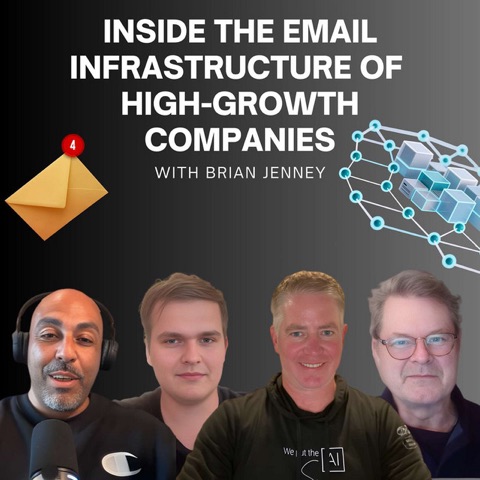
Inside the email infrastructure of high-growth companies
Develop Yourself with Brian Jenney, alongside Seventh Sense founder Mike Donnelly Listen on SpotifyWhy a marketer is doing a doctorate in information technology
When I was working on my bachelor's in international business, I thought the international part was somehow separate from business. It is not. Pick up a laptop, a pen, a notebook or a shirt, and odds are it was made abroad or moved through an international supply chain. I would argue all business is international.
Information technology works the same way. It is not only software, data analysis or computer science. Information comes first and technology follows it. Almost everything we touch now is information technology. Seriously, that is just the nature of the world we live in.
Marketing, my craft, is no exception. In my view, marketing is just a wrapper word for understanding human behavior, run on information and on technology. So I decided to study it through the technical lens. I consider myself a tech-savvy marketer, and the doctorate is where that gets tested.
Data partners
Organizations that share de-identified data for my studies. They see the findings first. 2 partners so far, and room for more.
Seventh Sense
Email optimization and analytics software for HubSpot and Marketo
Arobis AI
GEO, AEO and AI SEO agency for B2B SaaS
Open slot
Your organization · sector · data type
Become a data partner
Does your team sit on marketing, sales or product data, with a question nobody has time to answer properly? That is the kind of partnership this research runs on. Free to participate. Again, no commercial incentive. Just science.
Reach out on LinkedIn or email boris@optimizehub.net.
- Your data stays yours. A written data use agreement, de-identified before analysis, never resold, never used in consulting.
- Questions we design together. 1 or 2 questions your team actually wants answered, not a survey dropped in your inbox.
- Findings first. Results and benchmarks before anything is published, and credit on this page if you want it.
- Backed by research, on your own site. Once the findings are out, you can say the question your team asked was answered by a study, and link to it.
Research
My research grows out of my day job: how products get found, how ratings get made, and what a shopper can trust. I am early in the program, so this section will change as the proposal takes shape.
A transparency layer for product rankings
Public ratings are shaped by marketing: fabricated reviews, undisclosed affiliate content, review gating, satellite sites built for backlinks. The tool I have in mind builds a baseline ranking for a set of products from public data. Then it re-ranks them after accounting for those tactics. The shopper sees a ranking they can trust, and the reasons behind it. Transparency is the point, not catching anyone.
QuestionDoes a ranking that accounts for marketing tactics feel more credible to shoppers than the platform's own?
MethodSignal detection per tactic, a re-ranking model, and surveys with consumers and marketers. Any survey goes through IRB review first.
Scope1 product category to start, then widen. Fakespot is 1 case study I am learning from.
StatusIdea stage, refined weekly with my mentor. No proposal yet.
From a list to a ranking I can defend
I made up this search and these 5 toothpastes.
-
Rank 1
Toothpaste D3,410 reviewsdown 1
- 01Fabricated reviewsThe same review text appears on 3 other products
1 signal, in the reviews: 4.4 − 0.6 = 3.8. It ends 5th.
Platform 4.4Adjusted 3.8 -
Rank 2
Toothpaste A2,140 reviewsdown 3
- 01Fabricated reviews610 of 2,140 reviews arrived within the same 4 days
- 08Review gating1-star share is 1% here and 9% on 2 other sites
2 signals, both in the reviews: 4.9 − 0.6 − 0.4 = 3.9.
Platform 4.9Adjusted 3.9 -
Rank 3
Toothpaste E540 reviewsup 2
No signals found. Nothing to adjust, so 4.2 stands. It moves up 2 places.
Platform 4.2Adjusted 4.2 -
Rank 4
Toothpaste B860 reviewssame place
- 05Inflated "was" pricesThe "was" price was charged on 3 of the last 90 days
1 minor signal, about price: 4.7 − 0.2 = 4.5. It stays 2nd.
Platform 4.7Adjusted 4.5 -
Rank 5
Toothpaste C1,320 reviewsup 2
No signals found. Nothing to adjust, so 4.6 stands. It moves up to 1st.
Platform 4.6Adjusted 4.6
Illustration only. I made up the products, ratings and signals, and the model does not exist yet. The deductions (0.6, 0.4, 0.2) are placeholders I picked. Nothing here is a finding about a real product, brand, seller or platform.
What my tool would potentially look for
01Fabricated reviews
Review classifiers, reviewer behavior graphs, timing bursts, near-duplicate text across products
02Satellite sites for backlinks
Shared hosting, analytics IDs and templates, heavy interlinking, thin content
03Undisclosed affiliate content
Affiliate URL parameters, missing disclosures on "neutral" reviews
04Fake scarcity and urgency
Timers that reset on reload, identical counters across products, evergreen "sales"
05Inflated "was" prices
Price history and page history
06Hidden text aimed at AI crawlers
Hidden CSS or white text, content served only to bots
07Astroturfing in forums
Account age, coordinated posting patterns, same phrasing across accounts
08Review gating
Rating distributions that do not match across platforms, near-zero negatives
09Pay-to-play badges and awards
Check that the awarding body exists and is independent, and that the seal links to a verifiable page
10Bought followers, likes and views
Engagement rate against follower count, bot-like account clusters
Surveys
Surveys with shoppers and marketers are part of the planned study design, and they will run from this page. Nothing opens before the protocol clears ASU's review board. Every survey will state who it is for, how long it takes and how answers are stored before you begin.
Opens after IRB approval
How much do you trust product ratings?
The first survey will ask shoppers which signals make a rating believable and which ones make them walk away. It will also ask whether seeing the reasons behind a ranking changes their choice.
Take the survey
Hear about the next survey
Send me a 1-line email and I will add you to the list. You get 1 message when a survey opens, and 1 when the results are out. Nothing else.
No list software behind this. Your email sits in my inbox, nowhere else.
- Consent first, on the survey's own first page.
- Anonymous by default. No names, no emails inside the survey.
- Results come back here as a short summary.
Working on something where marketing, data and AI meet? Let's talk.
Research partnerships, speaking, or a marketing systems question. Email is the fastest way to reach me.
boris@optimizehub.net